Wednesday, 10 March 2010

Title Sequence Ideas

In any film, the title sequence is very important. It doesn’t matter when the title sequence is shown, it sets the tone for the film and from it, the audience have connotations of what to expect from this particular film. For example, a romantic comedy film would usually have simple titles, with an easy to read font and light colours. They may have shots of summer or photographs in the background, to introduce a happy atmosphere. In a horror film though, the titles will be shown in a much different font, one that may look like it has been scrawled on a piece of paper. The colours will be dark, and if any images are being shown in the background, they will usually be of gruesome things.

This is the same in our film, we want to create a huge sense of dread and tension with our title sequence. Approximately two minutes of footage will be shown before our title sequence, and it will be very dark and gritty. We want our credits to carry a similar tone, and make the audience feel trapped and in anguish, as if they are part of the film themselves.

Whilst we have only had initial ideas for our title sequence, we think it should have a font that looks as if it has not been written by a mentally healthy person. If we used a font that was simple, it wouldn’t have the same effect and would not keep the tension rising. A title sequence that influenced us was from the film ‘Se7en’ (Dir. David Fincher, 1995). The title sequence at the time was revolutionary, as the words were flashed across the screen and were very hard to read. This gave the film an immediate dark and murky feel, an atmosphere that is carried on throughout. We thought this was an excellent title sequence and we want to emulate it with something similar.

We have also not decided yet whether our title sequence will have images being shown in the background as the words are shown on screen. This has proved effective in many films, such as ‘Memento’ (Dir. Christopher Nolan, 2000) and ‘Panic Room’ (Dir. David Fincher, 2002). These title sequences have proved effective as the world represented in the film is shown as the first shots, setting the scene and introducing the audience to where the film will be set. Using these shots among the credits also allow for advancement in the story, even though no words are usually spoken.

Another aspect we will have to focus on is the music that will be heard during our title sequence. This is another important feature as it tells the audience what the mood of the film is going to be like and what they should expect from it. This can be altered however, with the use of contrapuntal sound, which would send the audience in a different direction and make them wonder why the music is so different to what is being shown on screen and what they should expect from the rest of the film. Some title sequences that used music well that we took influences from were ‘Déjà Vu’ (Dir. Tony Scott, 2006) and ‘Inside Man’ (Dir. Spike Lee, 2006). ‘Déjà Vu’ was an especially heavy influence on us as it used music contrapuntally very well. The song ‘Don’t Worry Baby’ by The Beach Boys is played as a huge ship is blowing up. This use of music, at first, puts the audience into a calm mood, as it is a relaxing song, which makes them more shocked when the ship explodes. We thought this was a extremely well thought out opening and may use similar aspects in our thriller.


- Taylor Gladwin

Brief - Example of Camera Shots

In our thriller, to gain marks we must use and incorporate a differently variety of camera shots into our opening two minutes. As we are filming in two different locations, the shots we can use, along with the way we have the camera can be greatly utilised, thus gaining us extra marks. This also allows us to give other years that do Media Studies an opportunity to learn from what we did and incorporate our camera shots into their thrillers in the future.

At the very beginning of our thriller we see so nympheas growing in a field, with a possible breeze to show the harmony that the flowers represent. As the camera pans up, we see a man has been hanged from an isolated tree. The contrast between the two shots already creates enigmas, such as why are the nympheas so important? Who is that man and why has been hanged?

One of our most interesting and key shots is the shot where the pills drop onto a screen on top of the camera. We plan to do this by holding up a piece of clear plastic on top of the camera to which the pill pot shall fall on. Upon impact the pot shall explode open releasing the pills shall spread across the screen, as if they had fallen on the floor.

Our main interest in our opening is to create as many enigmas as possible that shall later be solved in the thriller. The main camera shots used for this are shot of people looking into frame space. we do plan to incorporate this into the two minutes for as long as we can before we reveal what it is the character is looking at.This will most likely be used in the handing over of the business card from Brad's character to Taylor's character. The prolonged looking into frame space will create enigmas umong the audience to what might be on the card and it's relevance to the events taht are occuring in this sequence. However, once the wording on the card is revealed more enigmas will be created, such as what does this mean?

Overall these wide variety of camera shots should give us the interest from the audience we plan to create and get the marks we want from the examiner. This also gives us great creativity for future project we do this year or next year.

- David Huxford

Coming up with a name for our thriller

Our thriller was going to be based around the idea of a psychological thriller which will contain a lot of enigmas. To back this up we needed a name that would represent and create an identity through the title of our thriller. We had the idea of using a card at the end of our film which will contain a word which will then leave the 2 minute's at a cliff hanger. We also the idea that the word on the card could be connected to the title of the film, this would make it obvious that the word has an important meaning. After coming up with a few ideas we then decided on the word Nymphia as out title.

- Tom Winn

Tuesday, 9 March 2010

Specific Iconography

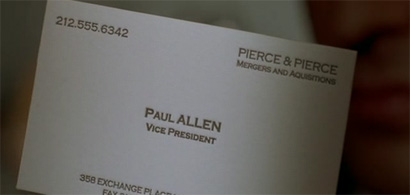
In our film, one very important piece of iconography we will be using is a card, similar to a business card and about the size of a playing card. In our film, the character wearing the suit hands the other character the card just before the credits. The card is small, and will have the words ‘allegiance’ printed on it. We believe that this ends our opening sequence perfectly, as it creates many enigmas for the audience, and they wonder why the word is important and why the man is handing the other the card.

After receiving an idea about the card, we decided that this would be more intriguing than our other original ideas. We thought the use of cards left good cliff-hangers, and made the audience excited for more. The final scene from ‘Batman Begins’ (Dir. Christopher Nolan, 2005) was a big influence on us, as The Joker’s card is revealed to Batman. This was a perfect end to the film, and wetted the audience’s appetite for a sequel involving The Joker. We wanted to have a similar effect with our film. We think that the use of the card just before the opening credits will make the viewer wonder, and make them want to watch more and find out the significance of the card.

Another film that made us feel the idea of a card was a good one is ‘American Psycho’ (Dir. Mary Harron, 2000). In this film, the main character Patrick Bateman becomes obsessed and angry if someone else has a classier looking business card than him. We liked the effect that such a small and meaningless object could have on a character, and feel this is the kind of reaction we want to create in our thriller. Our character may have a similar reaction, or it may burn a hole deep inside him.

On the card, 'Allegiance' will be printed. This is a very unusual word, and we think this will create enigmas for the audience, and make them wonder why this card is important and what effects this word will have on the character. We decided to choose this word to put on the card, because it is a word that is not used in every day life and people may wonder what it means. We chose this over a number or address, because we thought it would have more impact and create more tension and enigmas.

By using the card as a piece of iconography, it creates a sense of mystery, and makes the audience wonder why it is so important and why it has such an impact on the character. We are hoping that this will be another reason that the audience will want to view the rest of our film, to find out all of the answers.

- Taylor Gladwin

Identifying Target Audience

When we were figuring out ideas for our film, we had to strongly consider who our target audience would be. When making a film, each company has to know what kind of people they will market it towards, and if this goes wrong it could lose them a lot of money. The company must decide what group of people are going to come and see the film the most. For example, an animated film is usually marketed at kids, since the storyline is usually very simple and there is no violence or swearing in it. On the other hand, a film that is rated 18 would not be marketed towards children. If it was, it would lose money and not many people would go to see it.

We decided to rate our film with a ‘15’ certificate, since it will involve swearing and drug abuse, with a little violence. We feel that this is the correct rating, since we feel many teenagers will see this film. Our specific target audience are teenagers, and adults (most probably men) that enjoy a complex story and a murky atmosphere. This will not be a very light-hearted film, so we will not market it towards younger viewers, and our marketing strategy would aim it at men, aged late teens and above. Our target audience will be similar to the audience that films like 'Stay' (Dir. Marc Forster, 2005) and 'The Game' (Dir. David Fincher, 1997) would aim for.

Our market strategy would involve some teaser trailers, barely showing any of the film itself, but intriguing the audience and making them want to see more. We would want the trailers to feel creepy and make viewers wonder what the film is about. We would also use teaser posters, keeping people wondering about the film. We believe that these techniques would bring hype to our film, and make people want to see it to find out exactly what it’s about. If we used normal trailers and posters with many images, it would give away too much about the film, and we want to keep it as secretive as possible. We want people to know barely anything about it before seeing the film.

Here is an excellent example of a teaser trailer, for 'The Dark Knight' (Dir. Christopher Nolan, 2008). We would want our teaser trailer to be similar to this, since it gives nothing away about the film, but immediately intrigues viewers and makes them want to find out more about the film. Also, because no actual images from the film are used, fans will want to go and find out what the characters look like. A similar strategy for our film would be very effective, we think, and would generate much interest for our film, even though it doesn't contain any stars and is low budget.


- Taylor Gladwin

Brief - Sound

Sound in thrillers is essential to creating the correct mood throughout the film. It creates a sense of confusion and wariness toward the audience. The audience then feels the emotion the director wants them to feel at a specific moment in the film, completing the task the sound was created for.

Non-digetic sound (sound that is added in pre production) is the main reason for the audience feeling different forms of emotion that the audience show towards a film. Eerie tense non-digetic soundtrack makes the audience feel scared and afraid of the sequence of events that is about to occur. Soundtrack involving a violin usually portrays sadness, making the audience feel upset to a point they may cry.

However, digetic sound can be uses effectively to portray a picture. A gun shot can portray a sense of violence, and laughter can portray a sense of humour. One film that uses this technique very effectively is No Country For Old Men (2007, Joel and Ethan Coen). Throughout the whole of the film, the directors purposefully don’t use any non-digetic sound. The directors rely completely on the digetic sound (sound that should be there) to portray the picture that they desire. This effect is used brilliantly as it creates a tense atmosphere throughout, as well as the special effects emphasise this point the directors try to make. Take into account the use of pleonastic sound, the choice of voices in the sequence and the lack of ambient sound to heighten the tension and keep the audience wanting more.


Another key aspect of sound that can influence audience reactions is contrapuntal sound. This is sound that is opposite to the action that is occurring. A famous example of this occurring is in the film A Clockwork Orange (1971, Stanley Kubrick) when Alex DeLage rapes a women whilst singing along to ‘Singing in the Rain'. This act usually suggests insanity amongst the cast, as well as quite effective in creating enigmas that are usually answered later on in the film.

These then for our thriller plan to be the main pieces of sound we plan to use in our thriller, as these are the main aspects in which we need to create the enigmas that we desire. Brad Hart gave us an inspiration for some eerie non digetic music from an application on his Ipod Touch. It was a keyboard application that allowed you to change your ipod into a keyboard and change the sounds like a real keyboard. The sounds he played were slow and deep, producing a soundtrack that would be perfect. Also in terms of contrapuntal sound, David huxford owns a music box a home that plays an interestingly relaxing tune. This music type would most likely be related to memories or a dream which we have in our thriller.

- David Huxford

Brief - Hybrid/Sub Genre, Lighting, Editing, Clearly Identifiable As A Thriller?

1)Based on initial planning stages is will your thriller be a hybrid or a sub genre?

In out initial planning stages, we had many ideas whether we will make it a hybrid of a sub genre or keep it as a thriller depending on our final idea. At first, the idea of a hybrid was very tempting because a hybrid allows us to experiment into other genre’s which then allows us to expand our target audience because the thriller will have different aspects of other genre’s, e.g. we could involve some horror to attract a different range of audience. The only problem that we could think of with using a hybrid is that it may distract us from the main aspect of the opening sequence of a thriller. When we thought about adding a sub genre onto the thriller we had to look at the benefits that it could create for us. We had idea's of using sub genre's like a 'action thriller', 'crime thriller' and other's like a 'psychological thriller'. This would enable us to branch out into other idea's for our thriller.

In the end we decided to make our film a sub genre which was a 'psychological thriller'. This was because we decided to base our storyline around the idea of enigma's and paranoia which will attract a wider audience and also it will add a good cliffhanger to the end of our 2 minute opening sequence.

2) What lightning techniques?

It was very difficult when we had to plan for our lighting. The idea of our thriller was to try and keep the lighting as dim as possible to create the sense of dull, depression and a bad environment which will represent the character and the location in our thriller. The problem that we thought about was that the location we had for our thriller meant that it was very hard to get the perfect lighting we had hoped for, this is because the time of day that we was going to film was going to be in the daylight, and the location itself had open window's meaning that a lot of the sunlight came through and didn't create the specific affect we was going for.

3) What types of editing techniques have you used?

We tried to keep the editing as smooth as possible to make it realistic, also we haven’t got the best editing software available so we couldn’t make any special effects which could have helped us. Although in our sequence we have used a type of editing which creates the affect of our character passing out. We done this by making the scene rapidly go in focus and out of focus. This created the affect we was looking for while only using simple editing techniques. Apart from that the editing we used was simple and easy to make the thriller flow well.

4) Based on your initial ideas, do you think your film will clearly identifiable as being a thriller?

Our initial ideas has made our film identifiable as a thriller very easily because of the iconographical things that we have placed in our thriller. For example, in our thriller we have used flashback's and only based our 2 minutes around one character which most thriller's do. Also in our film the storyline is very stereotypical of a thriller, for example at the begining we have used a flashback of a dead man, this is a typical stereotype that people associate with a common thriller.

Tom Winn